Showing posts with label city. Show all posts

Thursday, March 6, 2008

good planning in Afghanistan

Caption Reads: Ayno Maina as seen from a crumbling Soviet-era housing complex next door. The development is the brain child of Hamid Helmandi, an Afghan-American who builds homes in Southern California.

A Slice of U.S. Suburbia Springs up in Afghanistan. by Soraya Sarhaddi Nelson March 3, 2008. [All Things Considered] <http://www.npr.org/templates/story/story.php?storyId=87858936&ft=1&f=1004>.

Wednesday, March 5, 2008

JJ and KA

The small town life in down town residential areas embodies smaller business buildings that go higher. This keeps buildings at a minimal, and allows for the purity of the land to show through, as seen in the picture above. Note how the buildings have similar structural shape, general look to almost all of them.

JJ and SS


The photo not only captures New York‘s Central Park indicated by trees and accumulation of people, but it also exhibits the skyscrapers that indicate its business district location. The photo of ice skaters supports Jane Jacob’s belief that instead of “automatically uplifting their neighborhoods, neighborhood parks themselves are directly and drastically affected by the way the neighborhood acts upon them” (Jacobs 95). She believes that parks do not secure a cities success, but rather that apark’s vitality comes from that of its surroundings. The economic stability in the surrounding city secures a flourishing park. The park’s success is shown in the photo as people feel safe enough to take their friends and family ice skating during Christmas time. http://www.z-mation.com/phpbb/files/ny_wollman_rink_central_park_ice_skating_christmas _10_190.jpg

JJ and SN

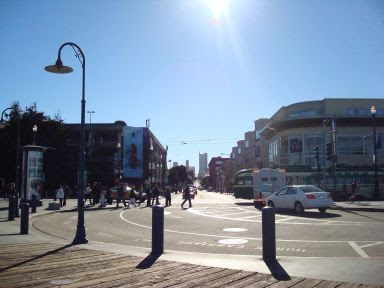
Sarah Nisar, San Francisco


This is a picture of downtown San Francisco I took when I went to the Bay Area last year. I love San Francisco because, in my opinion, it's not uniform. It's culturally diverse, but it makes me feel cozy when I go downt here because the houses are small, yet it gives me a warm feeling of joy and joyness. I think the context of this photo would pertain to Jacob's [emotional] reaction to the "innovated" North End in Boston. The prominent feature of the housing in SF is the [not overdone] Venetian touch. Jacobs mentions Venetian effects on the "renovated" North End in 1959. She also states, " The streets were alive with children playing, people shopping,people strolling, people taking." This description is also valid with SF,where the streets of downtown are always animated and crowded with people-but not in a claustrophobic manner- but in a unifying exciting feel. Jacobs states, "This ubiquitous principle is the need of cities for mostintricate and close-gained diversity of uses that give each other constantmutual support, both economically and socially." I can take this text from Jacobs and apply it to the San Francisco city. The thing that stands outmost to me about SF, is that the mutual relationship among the communityis not forced, but instead, it is a rather natural occurrence. Even though SF is really busy, I believe that it contains elements that fit Jacobs' criteria.

JJ and CV

Our Patch of Grass on Flickr - Photo Sharing!

This image shows a small patch of grass growing out of the seeminglyfutility aspects of sustainable life. Also, in the background, it showspatches grass against an apartment.I was inspired by the articulate tenant quote, on page 15, "Nobody caredwhat we need. But the big men come and look at the grass and say, 'Isn'tit wonderful! Now the poor have everything!' "Just because an area contains grass, does not mean the people in the areashare the same golden, idealist qualities associated with grass. What madethat quote more memorable to me was the reality in which previous homeowners were torn away from their houses, relocate to a different place,and then expect them to live happily ever after.

Tuesday, March 4, 2008

JJ and KG

Karen Gonzalez, January 31st, 2008. Outside Kodak Theatre

The image was taken outside in a shopping center in front of the Kodak theatre where a democratic debate was ensuing between Barack Obama and Hilary Clinton. The image is of an urban center turned inward, away from the sidewalk. In Jane Jacob’s book, “The Death And Life of Great American Cities”, the concept that sidewalks improve safely because they place “eyes upon the street” is not evident in this image. The problem with this shopping center is that it is “turned inward onto courtyards, away from streets and sidewalks”. This can lead to gang territory and it can fortress the wealthy that can afford this high-end shopping center.

JJ and AB

Asad Bedran, Echo Park Graffiti


The attached photo depicts a graffiti covered wall at Echo Park in Los Angeles, California. Jane Jacobs dislikes parks and loved sidewalks, as Professor Lupton highlighted in lecture, the reasons regard social interaction. In this photograph Echo Park, once a beautiful park designed for social activity, has been enclosed by commercial communities in responce to an expanding Downtown Los Angeles. The park is a popular hangout spot for local gangs and that discourages public interaction. So this supports her dislike of parks with comparison to the more publicly used sidewalks/ city streets. A nice comparison would be to look at a photo of a sidewalk in Downtown on a work day or Hollywood on a weekend.

JJ and EM

Los Angeles. “A Prison or Apartments?”

It isn’t a prison or jail, but apartments where low-income families live in Los Angeles. Jane Jacobs’ take: Ethnicity is a form of urban diversity, but she doesn’t use race as an analytical category. However, because of the lack of race development as an analytic category, the effectiveness of her argument is significantly weakened. Nevertheless, the slums remain a major gang territory for the poor and lastly; there is no commerce or street life to keep “eyes on the street” (e.g. use of sidewalks).

Menchaca, Michelle. _A Prison or Apartments?_ Flickr, Los Angeles. _Flickr_. 4 Mar. 2008 <http://flickr.com/photos/florecita_roquera86/>.

JJ and RM

Rani Mansuri, Laguna Hills

This picture represents one of the calm and peaceful and green neighborhood in Laguna Hills. This picture, rather than being of a typical busy street in an urban location, is of suburban living, with houses close to each other, neighbors who know each other and people who take evening walks with their mates. This image in a way, illustrates the idea that sidewalks and streets are important in life and how they affect human excitement and interaction. The boy is skateboarding down an empty road that runs right through the center of the block, where everyone can see him and he can see everyone. This also, as far-fetched as it sounds, can coincide with Jacobs' idea that strangers can meet and interact with one another. Jacob's says that she "wants to understand the kinds of activityand relationship that streets and sidewalks support...". If, in this picture, there were no sidewalks, or no street, kids and people wouldn't be able to enjoy the nature surrounding them. It sort of "assimilates children" to public and social life. But in a way, it also contradicts what Jacobs' proposes in that she wants to get kids "off the street" whereas this kid is using the street to meet a friend, or going for a fun ride, or just getting home.

JJ and ES

Evan Stanfield, Irvine Graffiti Tunnel

Jane Jacobs book is, as you know, about urban planning and the lack of feeling and emotion that modernistic city planning maintains today. Jane feels that this "rational" planning is only hindering the creativity seen in humans and rejects any sort of the individuality and creativity that human beings seem to love and thrive in. She doesn't like the separation of industry from suburban communities because it creates isolated, unnatural urban and communal spaces. Which is why i chose this picture...this is a hidden tunnel near UCI that is full or graffiti...its also know as the graffiti tunnel. This hidden tunnel shows the chaos and the hidden jems that can be found in a city that i feel has no culture or flavor.